Showing posts with label The Natural History of Small French Children. Show all posts

Friday, June 4, 2010

Creatures Great and Small

Les Animaux

Last Thursday, I accompanied École Dirigeable on a school trip to Paris, where we visited the Galerie de Paléontologie et d’Anatomie Comparée and the Grande Galerie de l’Évolution at the Museum of Natural History.  The trip had all the predictable pleasures of looking at dinosaurs and stuffed giraffes in the company of children: the childlike wonder with which the students admired the tail bones of an Apatosaurus; the childlike mischievousness with which students who had illicitly touched the taxidermied specimens sought to “contaminate” their classmates; and the all too adult anxiety with which the students fussed over their digital cameras.  Between gallery visits we had a rainy picnic in the Jardin des Plantes and played What Time is it, Mr. Wolf?, churning up the gravel alleys under the horrified eyes of the paramilitary gardeners who consoled themselves by rigorously enforcing the prohibitions of walking on, placing bags on or even looking at the garden’s lawns.  How did you say pelouse interdite in English, the small French children wanted to know, and I had to resist the temptation of offering them the unidiomatic calque of ‘forbidden lawn.’
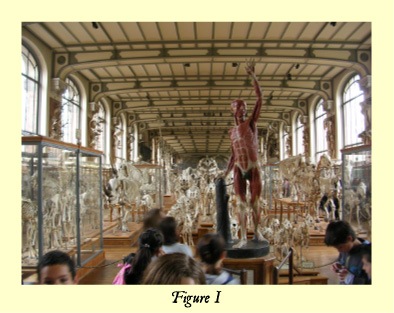
homo explorator The day’s real surprise was the museum itself.  Unlike its gleaming analogues in London or New York, redolent of cutting edge museological pedagogy, the Galerie de Paléontologie et d’Anatomie Comparée seems to have survived the last half-century virtually untouched.  The ground floor of the imposing 19th-century pavilion (Figure I) is filled with skeletons of extant species, while display cases around  the walls are packed with smaller specimens, each with a handwritten label; the upper floor contains a similar gallery of vertebrate fossils, overlooked by the invertebrates in the mezzanine.  Aside from the labels, there is little explanatory material, and almost no printed or electronic graphical content; and the labels themselves casually assume that the visitor is familiar with both caecum and duodenum.  Yet, rather than rendering the collections dry, or uninteresting, this intellectual seriousness and simplicity of presentation conveys magnificently the curiosity about the world and the excitement of discovery which surely underlies the entire project of natural history.  Who needs shiny pictures and dumbed-down exegesis?, the gallery seems to ask – look, here is nature! And here is nature, in all its variety: items which, at other museums, are hidden away in subterranean storage closets – cyclopic kittens, two-headed ducklings, kangaroo livers and crucified and dissected cats – here appear proudly, floating their jars of formaldehyde.  As realized here, the museum is not only a ghetto for hyperactive children, but proudly advertises its original function, as a place for serious scientific contemplation, and a monument to human curiosity.  It is surely no accident that first sight on entering the gallery is model human body, striding forward, arm raised triumphantly – an appropriate avatar for the museum’s curators and visitors alike.

Nef avant restauration While the Galerie de Paléontologie et d’Anatomie Comparée seems to have passed through recent decades unchanged, the Grande Galerie d’Évolution spent much of the last half-century in a state of total neglect.  Closed to the public in 1966 as a result of leaks in its roof, the Galerie de Zoologie, home to the museum’s collection of stuffed animals, was covered by an emergency metal roof in 1968, plunging it “dans la pénombre,”  according to the font of human wisdom, and transforming it into “une immense cathédrale immobile” (Figure II); only in 1994 was the space reopened as the Grande Galerie.  Owing to this recent restoration, this gallery is unmistakably modern, complete with explanatory displays, video presentations, and electronic activities.  Even so, it, like the gallery of comparative anatomy, retains a not-quite-contemporary aura, some vestige of the orientalism and exoticism which must have motivated the men who hunted and collected these specimens in the nineteenth and early twentieth centuries, a spirit exemplified by a reconstruction of a tiger attack experienced by the Duc d’Orléans and Prince d’Orléans while on a tiger  hunting expedition in India, a display in which the unlucky stuffed tiger is reprising his role from the day itself (Figure III).  Within the vast, dimly lit, Eiffel-era pavilion, dramatic spotlights pick out the specimens which, rather than being confined in Le Tigre et l'Elephantglass cases, stand exposed behind low guardrails.  With the exception of the Tiger and the Elephant there are no dioramas here, no attempts made to situate the creatures among the authentic grasses and rodents of their native habitats.  Instead, the pièce de résistance is the cavalcade of African savannah mammals which snakes diagonally across the gallery’s central floor, giraffes leading hippopotamuses marching in step with water buffalo.  Although entirely unrealistic, the display doesn’t come across as cheap sensationalism, but rather as a healthy embrace of spectacle, a fitting acknowledgement that we want to see these animals not simply (or even primarily) to learn about them, but also because they excite our imaginations.  Like the Galerie de Paléontologie et d’Anatomie Comparée, the Grande Galerie captures the specificity of a museum’s public function: in this case as not only a neutral repository of information and dispenser of educational activities, but also a kind of theatre to which we come in order to be amazed, delighted, and entertained.

At the end of the day, our return to Beauvais was delayed by a large demonstration directly in front of the Jardin des Plantes – linked to the day’s national strike in protest against the government’s proposed reform of the retirement system – which prevented our buses from returning on time to collect us.  The small French children were very taken with the protest: “ah yes,” they said, matter-of-factly, “those are the fonctionnaires on strike.”  As the wait dragged on, their attitude towards the strikers shifted from interest to unconscious emulation.  “There’s no way I’m coming to school tomorrow,” more than one student declared, “It’s just ridiculous.  I won’t be home until 11 PM, and then I’ll have to eat dinner, and I won’t be in bed before midnight.  How could I possibly get up for class in the morning?  Outrageous!”


***


Then again, perhaps the real reason I so enjoyed this trip to the museum was simply the joy which every overgrown child gets from looking at wild animals.  On Sunday, I returned to Paris by myself to see a retrospective of husband-and-wife sculptors and furniture designers François-Xavier and Claude Lalanne at the Musée des Arts décoratifs.  Animals and plants are the sole subject of the Lalannes’ whimsical oeuvres, and my visit to the exhibition was one of the most joyful hours I have ever spent in a museum.  A wonderful spirit of magic realism suffuses many of the pieces on display, ranging from François Xavier’s larger-than-life sized sheet metal sculptures of minotaurs and hoofed rabbits, standing calmly on strips of Astroturf, to Claude’s cabbages with feet and miniatures of snails metamorphosing into human thumbs (although the exhibition is entitled Les Lalanne, the two artists rarely collaborated on individual pieces).  François-Xavier’s work, in particular, blurs the line between sculpture and furniture to terrific comic effect: a hippopotamus whose belly opens up into a bathtub, and whose mouth becomes a sink; birds with lamps for tail feathers; a series of rhinoceroses which fold out into writing desks or disassemble into armchairs.  Most magical of all, though, are his monumental, gimmick-less animal sculptures which blend realism with the irrepressible joy of plush toys and cartoons: a herd of bronze-and-wool sheep, on casters for easy realignment, or a pair of impossibly shaggy metal and wool camels, perched contentedly on their Plexiglas dunes.


 

Chameaux

Chameaux Source

Friday, March 19, 2010

The Beatles meet Small French Children in the Age of YouTube

A minor emulous craze for singing Beatles songs in English class has overtaken the teachers at École Rex, who generally stay out of language lesson planning.  One teacher – who, notably, is possessed of both a singing voice and guitar – taught his class “Hello Goodbye” a month ago, and in the last couple weeks I – who possess neither – have been asked to teach that song to one class, and “Yellow Submarine” to another.  Despite my initial scepticism, the experience has been delightful; among its singular pleasures has been observing my students’ reactions to latter song’s lyrics (“they sailed to the sun?  the sea is green? le pays des sous-marins?) and listening to a chorus of nine year-olds singing the “oh no’s” of the former.

Being eager to further discharge my responsibility for cultural education, I also showed all three classes videos of the Beatles performing these songs,  in a clip from the eponymous film for “Yellow Submarine”, and in an appearance on the Ed Sullivan show for “Hello Goodbye.”  The small French children watched gravely, clapped dutifully, and then consigned the sexual obsessions of the 1960s to the poubelle of history by remarking wonderingly, “mais, ils sont moches, les Beatles, n’est-ce pas?

Thursday, March 4, 2010

Epiſode Eleven: Return to Bellovacum; in which the Author apologizes for his Prolonged Silence

Last week, I returned to Bellovacum after two weeks of vacances d’hiver, a period of time in which all French teachers go skiing, along with many small French children (and, presumably, their larger French parents).  Less fortunate small French children remain home watching television, although at least this year they were able to watch skiing at the Winter Olympics: the imaginations of my students seem to have been particularly captured by the biathlon.  The French often refer to les jeux Olympiques by their initials, and my trip to my home and native land have encouraged both my students and colleagues to ask me about “les geo”; my blank stares in response have, I feared, gone some way to undermining my cultural authenticity.

Although this is now the third time I have come back here from a vacation (and there’s still one more to go!) this has been the most defamiliarizing homecoming yet, perhaps because spending two weeks amid the old scenes and routines of Montreal has restored some of Bellovacum’s novelty.  The march of the seasons also seems to have accelerated in my absence: the days have lengthened enough that it’s now always worthwhile to roll up my blinds, and during the sun’s two brief appearances last week one could clearly catch the scent of spring.

This same sense of newness is particularly noticeable in the classroom.  On Thursday, for example, while teaching a class of seven and eight year-olds and still possibly experiencing the hallucinatory effects of le décalage horaire, I was suddenly overcome by an epiphanic realization of how strange a place primary school actually is.  It is an oddly coercive environment, in which what are essentially administrative punishments – being made to stand behind in another teacher’s classroom, deprived of recess, or hauled before the director – take on an awesome juridicial force, and in which the entire enterprise of teaching sometimes seems best understood as a struggle to force children to attend to their better natures, to their curiosity and eagerness, in the face of their evident preference for talking and playing amongst themselves.   Perhaps what was most startling was my realization that this has all come to seem perfectly natural to me, that in six months I too have come to think in a currency of lost recrés and punitions served.  At the same time, because I will have no real long-term involvement in my students’ education, my time in the classroom still feels like competitive play: each lesson is a game, in which, if my students end up learning something, I can declare myself the winner.

Friday brought another reminder of the personality-altering power of classroom discipline over small French children.  At École L’Arlésienne,  the teacher-cum-drill sergeant of my first class has decided to divide the class in two each week, so that we can work more flexibly in small groups.  Despite my initial laid-back scepticism about traditional French scholastic authoritarianism, I’ve come to relish the angelic regimentation of this class, particularly as the remainder of each Friday afternoon usually leaves me feeling like Yeats’ falconer.  In other circumstances I would have been concerned about this strategy of divide-and-rule, which the other teachers at L’Arlésienne have also tried, with near-apocalyptic results; this class, however, seemed so dutiful, so eager, that I couldn’t quite believe that their attentiveness derived purely from fear and oversight.  And yet, no sooner had the teacher departed with the other half of the class and with her dire warnings still hanging in the air, than an insurrectionist cell of boys declared itself in a chorus of complaints, recriminations, snitching and gros mots.  Suddenly aspects of the class of which I’d thought nothing became meaningful: that’s why little Yann always sits by himself at the front of the class, that explains adorable Ahmed’s special seat in the back corner.  As one boy whined, another sulked, and a third hit both of them over the head with an empty water bottle, I found myself wishing that the ideological state apparatus would hurry up and get this whole interpellation business over with.

Wednesday, January 13, 2010

The Wiſdom of Small French Children, Part the Firſt, & other matters

Another half-week has now come to a close; as there is no school for small French children on Wednesdays, what for other people is the darkest mid-week hump is for me a semi-weekend.  This particular subspecies of four-day week produces some charming effects: on Tuesday afternoons, teachers wish each other bon mercredi!; my attempts to teach my students the words “week” and “weekend” founder on their inability to comprehend a world in which schoolchildren go to class for five days in a row; and the government frequently cites as an achievement the fact that the children of France are no longer tired.

Bus Sign - Gameboy The past two days have had their share of daily and largely inconsequential amusements, many of them connected to the subjects of recent instalments of the Historiae.  On Monday, I found myself once again riding the iconographobus.i Sitting on the opposite side of the bus this time round, I was able to spot two more peculiar bits of signage (Fig. 1).  As the tagline for Le Symbole Perdu would have it, this truly is un secret depuis la nuit des temps.

Monday and Tuesday also saw the small French children at their Socratic best.  The linguistic naivety of my charges, I now realize, is but one manifestation of their larger to understand what it means that I am Canadian.  Just as the students at École L’Arlesienne have difficulty reconciling being Canadian with speaking French, some students at École Rex believe that being Canadian is incompatible with living in France: one eight year-old asked me on Tuesday whether I returned home of an evening to Canada or to Beauvais.

Not quite as adorably befuddled as this question, but more satisfying to my latent megalomania was the remark of her classmate in response to my valiant attempts to coral the class into orderly participation: Le maître est grand!  Il faut l’obéir!

A monument more lasting than bronze.

i In case you’re thinking of making a pilgrimage to see this rolling wonder of the modern world, at time of writing it runs on line 3, stopping at Délie on the way towards Saint-Lazare at 16h33 from Monday to Saturday.

Saturday, January 9, 2010

Cartable News Now

“While there is no doubt that wheeled luggage can, at its best, combine ergonomic comfort with the primal pleasure of manoeuvring a heavy vehicle, when used by children to carry their school things it is an unmistakeable sign of both physical and spiritual weakness.  The first united Europe was built by Roman legionaries who carried thirty kilograms of gear on their backs.  Watching their young successors wheeling their textbooks – already deracinated by Brussels overlords – behind them, one is made painfully yet unavoidably aware of the moral decay which is destroying relativistic Europe from within.” – Mark Coldhill, Europe, ‘Human Rights’ and the Tides of Dusk, pp.81-2.

When I was in Grades 7 and 8, a classmate of mine – one of the few who commuted in my direction – had a backpack that transformed into a miniature rolling suitcase.  The sight of him struggling to bump and drag his pack up the subway stairs before towing it off to school seemed, at the time, both darkly emblematic and silly: at one and the same time he appeared as a martyr to modernity’s stresses – the schoolchild transformed by the weight of educational drudgery into a grotesque prefiguration of the harried business traveller – and as a ridiculous oddity – the awkward kid who was, to put it simply, pulling his backpack behind him on wheels.

Across a decade and the pond, however, children with rolling backpacks are no longer rarae aves.  Every one of my charges has a cartable on wheels.  At 4:30 every day a file of children burst through the doors of École Rex and trundle their belongings across the schoolyard to where their parents and grandparents are waiting at the gates and looking uncannily like the crowd of relatives and chauffeurs who cluster around the arrival gates of international airports.  All through the afternoon rush-hour in Bellovacum children can be seen in harness.  They stand patiently, preternaturally matured by their pink and orange carry-on luggage, while their mothers borrow books at the library where I go to read the newspaper; they trail exhaustedly behind parents and older siblings down the Boulevard du Général de Gaulle; and, as dusk falls, they roll across the Thérain with wheels illuminated by red and blue LEDs.

While small French children may be highly adept at handling kindergarten rolling stock, they are less skilled at assessing linguistic competence.  In particular, they seem to have trouble reconciling the empirical fact that I can, in a manner of speaking, communicate in French and their a priori assumption that as both a foreigner and an English teacher I must surely speak only English.  Thus students with whom I have conversed in French, and who have evidently understood me and been understood by me still ask their teachers, “Maître, est-ce que Léon parle français?”  Like Renaissance devotees of Aristotle and Galen, they are prepared to ignore or reject their own observations of the world.  When asked – in French – whether I speak French, I generally answer – in French – that I don’t, before proceeding – also in French – to explain our next activity.  Everyone seems satisfied by this response.

Miscellanea Bellovacensia I

Saturday, November 28, 2009

Chapter 5, in which The Author makes more ſtrained analogies to a continent which will remain nameleſs and in which Small French Children comment upon his Height for the Firſt Time

Yesterday, at Ecole L’Arlésienne in the Viceroyalty of the Rio de la Plata, your correspondent found himself in the midst of a conflict reminiscent of the Guerra de las Malvinas.  The disruption occurred as a group of Small French Children and I were sitting in a circle on the floor, practicing our pronouns.  As ever, the children were responding with varying degrees of attentiveness – one of the males of species had already been banished to the corner of the class for refusing to stop breakdancing in the middle of circle, and his fellow boy children were either talking to each other constantly or becoming distressed by the continuing antics of the breakdancing exile.  The girls, in contrast and accordance with stereotype, were, by and large, being attentive and diligent – although one of them kept sneaking peeks at a picture book about ponies.

This pedagogical idyll, sadly was not long for our earth.  The breakdancer was soon lying on his stomach across several desks; the other children clamoured to be allowed to go report him to their teacher.  One boy cast aspersions on another’s grandmother’s maidenly honour – within seconds the injured party was pursuing the offender around the room and alternating fits of crying with the overturning of desks.  Two of most soft-spoken and studious girls in the class were demonstrating heretofore unsuspected capabilities of both vocal projection and English expression by screaming at the rest of the class to be quiet.  Others – the most eager collaborators of both sexes – pursued the combatants in the hopes of being the one to drag them off to their punishments.  Another girl was in tears, sure that she would never learn any English.  The picture-book reader immersed herself among her ponies.  The break-dancer did handstands.  Just like in Panama in 1989, peace could only be restored by application of external force to remove the malefactor – in the form of the teacher returning to the room to carry the brawlers off to be imprisoned in the salle informatique.

By contrast, my post-recré class was a model of moral rectitude; I was working outside with small groups, and only one malefactor had to be deported to the Devil’s Island of the classroom.  We passed the hour in pleasant comparative religious study, making sheep and turkey noises to illustrate the differences between Thanksgiving and Eid.  Near the end of the class, the conversation turned to that deep and challenging question: How Old Are You?  I informed the children of my age.  They seemed surprised.  “You’re young,” they wondered – “and tall for your age!”

Monday, November 23, 2009

Work and Play

Playground

As a former child prodigy playground designer, I liked this scene.

One of the most prominent features of working with small French children is the opportunity it affords to observe the behaviour and comportment of small children.  This is something which I have not really done since I was myself a small child, at which time my perspective was somewhat different.  More particularly, I get plenty of exposure (12 hours a week, to be exact) to life in elementary school – or as the French title of a 1988 Spike Lee film doesn’t put it, la vie en école primaire.

Now this, I know, does not sound very exotic; and you may rest assured, faithful and attentive reader, that I will not tax your patience with thousand-iron-tongued catalogues detailing my own pedagogic foibles or the delightful intricacies of classroom etiquette (and there came from Room 116 of Ecole Rex twenty cours préparatoire students bearing individual whiteboard-slates and markers…).  Yet, being back in primary school does produce an interesting kind of should-be deja-vu.  I have very happy memories of elementary school, but my recall of what the day-to-day life in the classroom was like is foggier – and being in these French classrooms lets me play at reconstructing my own childhood.  Of course, the fact that I was raised by wolves before being rescued by a magnanimous German monarch and encouraged to speak Hebrew makes any analogy between my childhood and that of my charges valid only on the vaguest level.

One feature of the chalk-dust coated life which caught my attention this week – and the subject of today’s uninformed and overly-portentous sermon – is the division between two models of classroom discipline evident in the schools in which I teach.  Some of the teachers with whom I work have adopted what I presume to be a more modern – at least for France – approach to classroom management.  Desks are arranged in groups, or islands, the students face, most of the time, in a variety of different directions, and the the entire class dynamic seems fairly relaxed – when I arrive at the door, the teacher is sometimes lecturing at the board, but as often is conducting the class from a seated, corner positions – or, less periphrastically, from behind his desk.  Discussion flows both ways – the kids are quizzed on questions, but also ask questions, or simply irrupt into the classroom’s airspace.  This way of arranging things is both both appealing and recognizable for me –  not least because of happy Annette St. hours spent thinking up historical narratives and board games centred around a conception of the desk group as a form of proto-nation-state (q.v. Wumprats).  When the system works, as it does in one classroom at my prosperous village school, it works very well – the class can be both attentive and easily and organically divided into smaller units for conversation, or for the bingo games that I take great delight in rigging.  Elsewhere, however, that way anarchy lies: in my other village classroom, as well as in my schools in the Viceroyalty of the Rio de la Plata, I often find myself able to command the attention of only one desk-cluster at a time – like guerrilla insurgencies in restive colonies, conversation is no sooner suppressed in one corner of the room, than it springs up in another.

In contrast, some of the other teachers in the Viceroyalty employ a far more traditional approach to classroom control.  Students sit in rows, only answer questions, don’t speak unless spoken to, and are regularly exhorted to answer faster and faster and faster.  As good Althusserian subjects, interpellated constantly by an ideological state apparatus, the children don’t even get to make their own nametags, but are issued them at their teachers’ whims.  These classes work, literally, like clockwork – the only possible form of dissent is a sullen silence.

The interesting, although perhaps stultifyingly obvious thing which lies behind these certainly stultifyingly obvious generalizations, is that in respect of ensuring that all the small French children learn some English, both systems produce identical results.  In the desk-nebulae classes, the least attentive students – or the least confident, or the quietest can simply disengage – any attempt to recover their attention would necessarily result in losing control of their excitable colleagues.  In the drill-sergeant classes, meanwhile, anyone who hesitates is simply left behind – as long they stay quiet, their more eager peers (who, like the ten year-old version of Your Author, spend the class valiantly trying to dislocate their arms from their shoulders) will gobble down all the questions.  It is a conundrum.

This observation, like all the best of its species, doesn’t in the end, have much of a point; nevertheless – and please brace yourselves for an Elegantly Chiastic Instance of Ring Composition Making Reference to The Title of the Entry – since text is play, it works.

Prior Inſtalments for the Week of